
Why UK Logistics Struggle Without Better Tech
Quick answer
Demand is rising, but outdated systems still slow dispatch, visibility, and coordination. Here’s why UK logistics businesses struggle without better tech.
Frequently asked questions
What is the main takeaway from "Why UK Logistics Struggle Without Better Tech"?
Demand is rising, but outdated systems still slow dispatch, visibility, and coordination. Here’s why UK logistics businesses struggle without better tech.
Who published "Why UK Logistics Struggle Without Better Tech"?
Trudosys published this article on 2025-10-30.
The UK logistics sector is under more pressure than it has seen in years. Demand has not slowed down. If anything, it has increased. E-commerce keeps growing, same-day deliveries are expected, and customers want real-time updates on everything they order. On the surface, business looks strong. But behind the scenes, many logistics companies are struggling to keep up.
The problem is not demand. The problem is that operations have become too complex to run on outdated systems. Many UK logistics businesses are still relying on manual processes, while expectations have moved far ahead. That gap is exactly where things start to break.
1. Manual operations are slowing down the entire supply chain
A lot of logistics operations still depend on spreadsheets, phone calls, WhatsApp updates, and disconnected software. Bookings are handled manually, routes are planned by hand, updates are shared late, and exceptions are fixed reactively. This slows things down across the entire operation. A late delivery will push the next pickup out of sync. A missed update will leave customers confused and frustrated. Manual systems can survive when volumes are low, but in 2025, UK logistics businesses are dealing with far more moving parts using tools that were built for a simpler time.
2. Staff shortages hit harder when tech is outdated
The UK logistics sector is facing serious workforce challenges. Drivers are hard to find. Warehouse staff turnover is high. Operations teams are stretched thin. But outdated tech makes the problem worse than it needs to be.
When systems are not automated, the existing team ends up doing repetitive work all day. Manually updating shipment statuses, answering customer queries, chasing confirmations, fixing scheduling errors, and coordinating internally. This increases burnout and makes retention even harder.
Better tech does not replace people. It removes unnecessary work so the people you do have can actually function.

3. Customers expect visibility that many businesses can’t provide
One of the biggest shifts in logistics is customer expectations. People now expect to know where their shipment is at every stage. They want notifications, tracking links, delivery windows, and instant updates when something changes.
Many UK logistics companies simply cannot provide this because their systems are not connected. Information exists, but it lives in different places. By the time it reaches the customer, it is outdated.
When customers feel unsure or left in the dark, trust drops quickly. And once trust drops, they look for a provider who offers clarity and transparency.
4. Lack of real-time data leads to poor decisions
Logistics is a data-driven business, but many operators still rely on guesswork. They guess peak delivery times. They guess route efficiency. They guess staffing needs. They guess where delays usually happen.
Without real-time dashboards and connected systems, decision-making becomes reactive. Problems are solved after they occur instead of being prevented. In a sector with tight margins, this constant firefighting slowly eats into profitability.
Businesses that survive are the ones that see problems early and adjust before things spiral.
5. Scaling becomes impossible with disconnected systems
A logistics business can have strong demand and still struggle to grow. The reason is simple. Manual workflows do not scale. They only stretch until something breaks.
As volume increases, errors increase. Delays increase. Customer complaints increase. Teams feel overwhelmed. Without proper automation and workflow systems, growth becomes a risk instead of an opportunity.
This is why many UK logistics businesses have hit the ceiling. Not because the market is small, but because their internal systems cannot handle more load.

6. Revenue leaks happen because there is no automation
Missed follow-ups, lost bookings, ignored messages, unread reports, delayed confirmations, and no-shows are all small issues individually. But when they happen every week, they become massive revenue leaks.
Simple automation around reminders, confirmations, customer updates, follow-ups, and scheduling can recover thousands in lost opportunities. Without it, logistics teams lose money quietly without realizing why.
Where Trudosys Fits In
UK logistics providers are not falling behind because they lack operational expertise. They are struggling because disconnected tools slow dispatch, communication, and internal coordination. Trudosys builds custom logistics systems that automate admin, streamline customer communication, reduce manual work, improve scheduling, coordinate drivers and shipments, and handle invoicing without increasing staff workload.
Your operation gets clearer workflows, faster communication, fewer errors, and a smoother end-to-end experience. Customers stay informed, staff feel relieved, and revenue rises naturally because your operations finally move at the speed modern logistics requires.
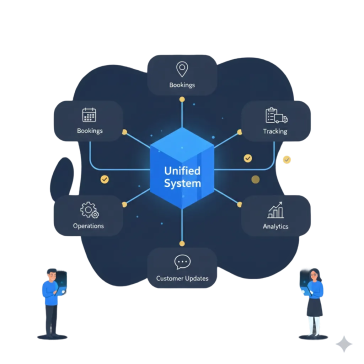
The logistics providers who upgrade their systems in 2025 will keep up. The ones who don’t will keep running into the same operational problems again and again.