
Why UK Businesses Are Turning to Technology in 2025
Quick answer
Rising costs and complexity are forcing UK businesses to rethink operations. Here’s why automation is becoming a necessity, not a luxury.
Frequently asked questions
What is the main takeaway from "Why UK Businesses Are Turning to Technology in 2025"?
Rising costs and complexity are forcing UK businesses to rethink operations. Here’s why automation is becoming a necessity, not a luxury.
Who published "Why UK Businesses Are Turning to Technology in 2025"?
Trudosys published this article on 2025-12-03.
Because the Labor Market Can’t Keep Up
If you run a business in the UK right now, you already know what the real struggle is. Demand is strong. Customers are willing to buy. Opportunities are everywhere. But you still feel stuck because you simply don’t have enough people to keep things moving. Every sector is dealing with the same pressure. Manufacturing is understaffed. Hospitality is stretched thin. Logistics is running at its limit. Even food services, which used to rely on quick hiring cycles, now struggle to fill basic roles.
The UK isn’t short of demand. It’s short of people. And that one sentence explains why businesses are finding it harder than ever to operate smoothly in 2025.
The Office for National Statistics recently reported one of the highest vacancy-to-labour ratios the UK has seen in years. That means businesses are trying to grow, but the workforce is not growing at the same pace. The problem is not ambition. It is capacity. Teams are doing the work of three people, and every week feels like a fight to keep up. This is where technology is stepping in as the quiet solution.
The labor gap is widening faster than businesses can react
Most UK businesses entered 2025 thinking demand was the biggest hurdle. Instead, they found something else. They could not hire fast enough. Even when they found candidates, they could not retain them. Staff turnover increased, training cycles became longer, and teams were exhausted trying to cover work that used to be shared across a bigger workforce.
The gap between what the business needs and what the team can deliver gets wider every month. When operations depend fully on manual work, the pressure becomes impossible to manage. Companies are not failing because of poor products or weak demand. They are failing because the business cannot run efficiently with the smaller teams they have.
Technology is no longer optional. It is the most practical way to close the labor gap without burning out the people who are still in the building.
Repetitive work is stealing hours from already stretched teams
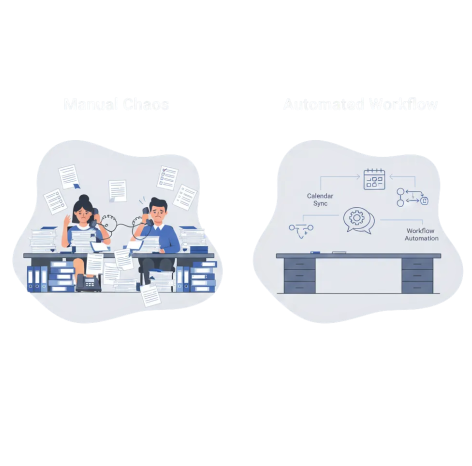
Every UK business has the same hidden drains. Staff spend hours every week answering repeated questions, updating basic information, sending confirmations, checking schedules, preparing manual reports, correcting small mistakes, or chasing follow-ups. None of these tasks needs human judgment, yet they continue to sit on someone’s plate because the systems are outdated.
When you are already understaffed, every wasted hour multiplies the pressure. Delays increase, mistakes increase, and customers feel the strain before leadership fully sees it.
This is not about replacing people. It is about giving your remaining team room to breathe by removing the repetitive work that should already be automated.
The customer experience breaks down first
Customers in the UK now expect instant replies, smooth digital journeys, clear communication, and fast resolutions. When a business is understaffed and under-supported, customer experience is usually the first thing to suffer.
Messages get delayed. Teams forget follow-ups. Mistakes slip in because there are not enough hands to keep everything moving. Technology helps by making the routine interactions automatic, which gives the team more space to handle the work that truly needs a human response.
Customers in the UK have grown used to speed. They expect instant replies, clear updates, and simple digital experiences. When that does not happen, they do not always complain. They simply move to a business that feels easier to deal with.
Tech tools fix this by making basic communication and coordination automatic. Customers get answers quickly. Payments, scheduling, reminders, and updates move without human involvement. Even small improvements in response time create a noticeable jump in customer satisfaction.
People do not leave because your team is incapable. They leave because the experience feels slow and fragmented.

Businesses can’t scale when everything depends on manual effort
A company can have strong demand and still fail to grow because the internal system collapses when pressure increases. Manual workflows don’t scale. They only stretch. And at some point, they break.
This is why UK businesses are now investing heavily in custom systems. Automation tools, workflow builders, AI assistants, and digital dashboards allow operations to grow without adding five new hires every time volume increases. Tech becomes the extra hands that the company cannot hire.
Businesses stop fighting fires and start planning again. They can take on more customers, manage higher demand, and run more smoothly even when the labor market leaves them short-staffed.
Where Trudosys Fits In
Most UK companies don’t need generic software. They need systems built around their exact operations. That is where Trudosys comes in. Trudosys builds custom automation and workflow tools that match how your business actually works. Instead of forcing your team to adjust to a template, the tech adapts to your process.
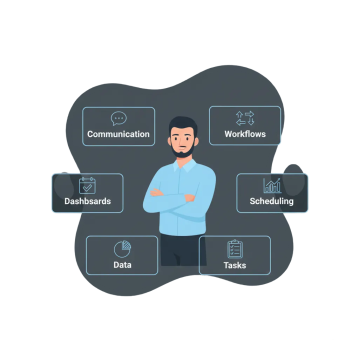
This gives you automated communication, cleaner operations, faster scheduling, better follow-ups, clearer data, and smoother internal workflows. Your team gets space to breathe, your customers feel more supported, and your business stays stable even when hiring is impossible.
The UK isn’t lacking opportunity. It’s lacking manpower. Trudosys fills that gap with tech that quietly carries the weight your team shouldn’t have to.